Showing posts with label Books. Show all posts

Sunday, April 17, 2011

Imaginary Author Writes Actual Bestseller


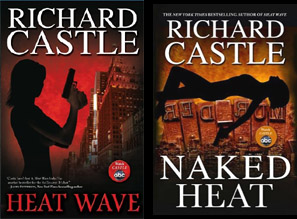
Novelist Richard Castle’s latest two books—Heat Wave, published in September 2009, and Naked Heat, published in September 2010—were met with favorable reviews and good sales, both of them hitting the New York Times, Barnes & Noble, and Amazon.com bestseller lists. Anticipation is building for Castle’s third novel, Heat Rises, due in autumn 2011.1

Rick Castle, as portrayed
by Canadian actor
Malcolm “Nathan Fillion”
Reynolds.
Millions of authors struggle to find publishers,2 and tens of thousands of published authors struggle to find an audience. To have come from absolutely nowhere just two short years ago and have not just one bestseller but two is quite an accomplishment for any author.

It’s even more impressive an accomplishment in this case, though, given that Richard Castle doesn’t actually exist.3 He’s a television character.

ABC’s Richard Castle has killed off Derrick Storm, the main character in his bestselling series of crime novels. Struggling with writers’s block, he uses his connections with the mayor—connections being a convenient benefit of being both famous and fictional—to get permission to shadow a New York Police Department homicide detective in the hopes of finding real-life inspiration.4

Rick Castle in real life.
That detective, Kate Beckett, spurs not only Castle’s creativity but also his libido: Beckett is very attractive and a secret admirer of Castle’s work—yet another way Castle benefits from being somebody else’s invention—but is also irritated by both his often-childish attitude and his surprising but off-kilter insight into cases. Their interactions borrow heavily but deftly from, among other things, the Moonlighting School of Character Interaction often described as “contempt breeds familiarity.” It’s only a matter of time before these two characters get together, and it remains to be seen only whether this will happen too early, a la Moonlighting, or far too late and much too off-screen, a la The X-Files.

While the timing and mechanics of Castle and Beckett’s unpredictable but inevitable naked collision may interest the casual viewer, we remain somewhat hung up on the non-author’s real-world literary success. We’re not angry, although we admit that we do empathize with those genuinely talented writers who toil in obscurity and even (sometimes self-imposed) anonymity while figments of others’ imaginations not only appear in New York Times bestsellers but now actively write them.

What truly troubles us is that it’s not only real writers that should be upset about Castle’s success. After twelve years on the air, Murder, She Wrote’s redoubtable Jessica Fletcher has published nearly forty novels, but suffers the shame of having to share writing credit with Donald Bain, the co-author whose paltry contributions to their collaboration are (a) writing the books and (b) existing in the first place. Fletcher herself presumably is forced to split the royalties with Bain, and is left to scrape out a meager existence among the heaps of corpses in sleepy Cabot Cove, murder capital of the modern world.5

Worse yet is the plight of Magnum P.I.’s Robin Masters. In early seasons, Masters (voiced by Orson Welles, but never seen in full) is depicted as a jetsetting, seldom-seen multimillionaire novelist on whose Hawai’i estate Magnum works as head of security. By the end of the series, though, Magnum has begun to suspect that his friend and occasional irritant Jonathan Quayle Higgins (also an estate employee) is the actual author of Masters’s novels, but that Higgins, believing them to be pulpy, ludicrous, and beneath his reputation as a serious memoirist, created the “Robin Masters” pen name and then hired an actor to portray Masters in a complex and expensive cover-up of the mundane and embarrassing truth.

Given that Jonathan Higgins is no more real than Richard Castle, Robin Masters therefore lives with the double indignity of not only having failed to write a single word ever published in the real world, but also—and more importantly—being a figment of the imagination of a man who was, himself, a figment of somebody’s imagination.

Rumor has it that Masters took this pretty hard for a while, but he’s feeling better now after some good long talks with his longtime friend Harvey.


NOTES
1.  We’re thankful that the title of the third book has strayed somewhat from Naked Heat’s “naughty double entendre” vibe. Continuing along the same ever-dirtier lines would have eventually resulted in the ultimate octuple-ententre of In Heat, which we suspect would be a bit too crass for much of Castle’s readership.
2. There’s often a very good reason for this: millions of unpublished authors are terrible, terrible writers. You don’t have to suck at writing to become an unpublished author, but it certainly does help.
3. Yes, we really did mean “absolutely nowhere.”
4. By “real-life,” we of course mean “not even remotely like real-life.”
5. According to the New York Times, in the twelve years of Murder She Wrote’s run, the number of murders in Cabot Cove, population 3,560, represented approximately 2% of its population.

Tuesday, December 1, 2009

Religion Embraces Evolution?

I appreciate Some Guy saying that he followed Monty Python's Flying Circus religiously. And while I can, unfortunately, confirm that he was a dork in high school (weren't we all?) I need to thank him for providing the foreshadowing to my post. For as I constantly strive to seek universal Truth (that's with a big T) I start to tackle the human condition known as religion (see what I did there - my bias on display already!).

The recent book "The Faith Instinct: How Religion Evolved and Why It Endures" by Nicholas Wade explores his theory that people have a genetic impulse to worship due to the natural selection benefit provided to early societies that adopted religion. I have read books on the historical development of religion, by both atheists (such as Richard Dawkins' "The God Delusion") and those of faith (including "The Dawkins Delusion" which I recently started), and I intend to put Mr. Wade's new addition on my list as well. Fortunately, my new favorite newspaper columnist, John Tierney of the New York Times Science section, did read it. The money quote (which includes a quote from the book itself):

In “The Faith Instinct,” after discussing some of the challenges to traditional beliefs (like the arguments of scholars that Jesus had little to do with the invention of Christianity, and that Muhammad might not even have existed), Nicholas notes that music appreciation, like religion, is a universal human faculty that draws people together, stirs the emotions, and exalts the mind to a different plane. He then observes:

Is there not some way of transforming religion into versions better suited for a modern age? The three monotheisms were created to meet conditions in societies that existed many centuries ago. The fact that they have endured for so long does not mean they were meant to last for ever, only that they have become like some favorite Mozart opera that people are happy to hear over and over again. But the world of music did not achieve final perfection in Mozart.

This is a brilliant observation by Mr. Wade. I hazard to guess that high-ranking officials in each of the Big Three Religions (in case you live under a rock - uh, a rock with Internet access - the Big Three consists of Christianity, Judaism and Islam) agree with portions of this sentiment. They DO need to evolve, and have done a piss-poor job of this in, oh, say the past 600 years. While standing around in their official garb (hey - it's a word!), the priest the rabbi and the imam (no, sadly this is not the beginning of a joke) would be loathe to admit that people only go because it has been something they are used to hearing over and over, like Mozart. It may not be a good reason, but it may just be the most common reason. And just like fans of the New York Yankees, they need to understand Mr. Wade's point - that just because they've been the winner before does not mean their institutions should endure.

Dawkins presents his argument in unabashedly indignant fashion, and this can feel like a club of the figurative head while reading his material. A biologist by education, Dawkins can (somewhat ironically - check me here, Some Guy) be "holier than thou" in his assertions, almost daring people to argue with him and giving off a vibe that if you beleive in God it is because you're not smart enough not to. But he brings with his arrogance a certain scientific credibility in his arguments. This is something I believe, for obvious reasons, the faithful cannot counter, for much of their argument boils down to "we believe it all happened, so it must have". This doesn't make it wrong, just as it doesn't make it right. On this issue, rarely do people use logic over emotion, and the discussion quickly breaks down.

Perhaps Dawkins' fatal flaw is that he doesn't distinguish between religion, faith and god, three very different ideas. God is the all-powerful being itself, and faith is the belief in.....well, something. But religion, while presumably based on the first two (faith in God) has become an entirely separate, almost corporate, entity, which can seemingly exist regardless of the actual existence of a supreme being. And maybe this is where Wade will shine, as he seems to identify a need to worship as something separate from the existence of god (or God, which ever he's talking about). Tierney wraps up his article discussing one idea for the evolution of religion:

What would the product of such a transformation look like? One possibility that occurs to me is a version of environmentalism, but with better music and with rituals that are more elegant than sorting garbage. A Church of Green could provide some of the same moral lessons and communal values as traditional religions, and I suspect it’s no coincidence that green fervor is especially prevalent in European countries where traditional religion is on the decline.

I can't wait to read Wade's contribution to the ancient and escalating debate. What do the faithful of Bowling in the Dark think?